Gemini 3.7 Flash: Google's Intelligent Workhorse Gets Faster and Cheaper

On this page
Gemini 3.7 Flash landed on August 13, 2026 — just three weeks after 3.6 Flash — as Google’s most intelligent workhorse model yet for coding and agents.
It is a clear algorithmic step-up driven by developer feedback, delivering real gains in software engineering, web development, knowledge work, and multi-step agentic execution, all while running at Flash-class latency and (temporarily) at half the previous price.
The coding jump that stands out
The biggest story for many of us is the leap in coding performance. On FrontierCode 1.1 Main (production code quality) it moves from 34.4% (3.6 Flash) to 43.6%. On DeepSWE v1.1 (long-horizon software engineering) it jumps from ~49% to 65.3%.
These are not toy evals. FrontierCode and DeepSWE test the kind of real debugging, issue resolution, and multi-file production work that actually matter. First-pass accuracy is higher and the model produces more usable code with fewer retries. Google is deliberately comparing against the relevant mid-to-high tier: Claude Sonnet 5, GPT-5.6 Terra, and Muse Spark 1.2 — not the absolute heaviest frontier models. That context matters. 3.7 Flash is punching in the same weight class as those models on coding while being dramatically cheaper and faster.
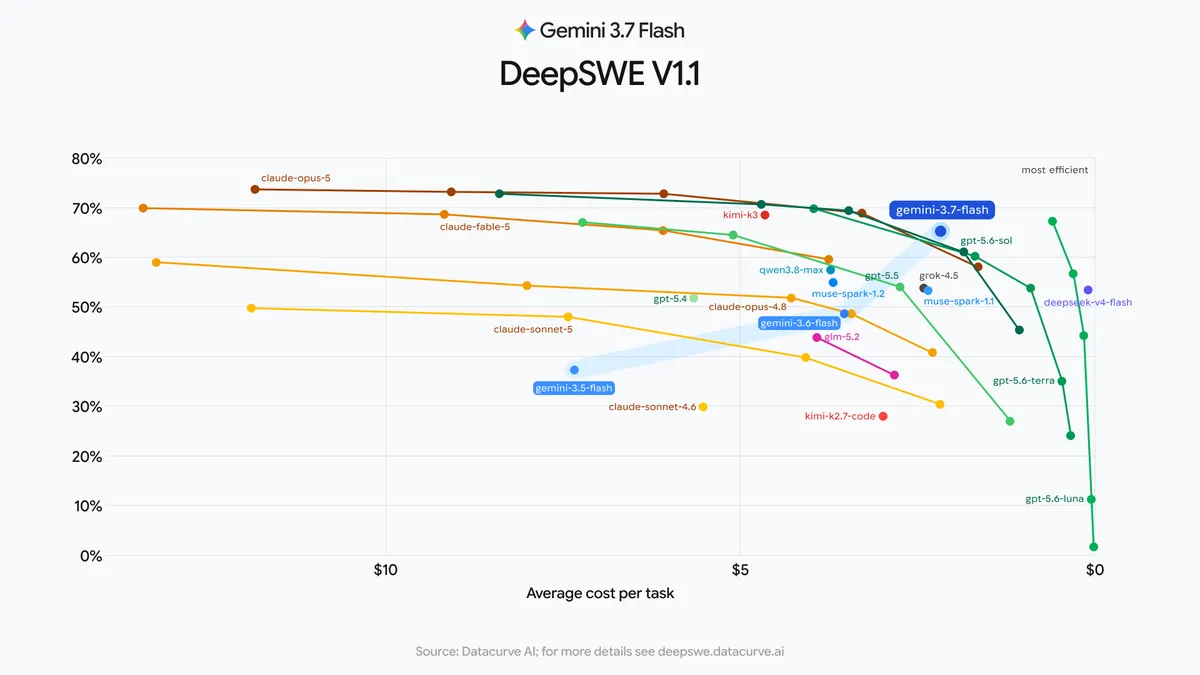
The DeepSWE cost-vs-quality Pareto shift is especially clean — Gemini 3.7 Flash sits in a very attractive region of the curve.
Ridiculous speed: ~340–341 tokens per second
Artificial Analysis measured Gemini 3.7 Flash (high) at 340.1 output tokens per second, ranking it #1 among the models they track. That is nearly 3× the speed of models like GPT-5.6 Terra on the same tasks. Combined with the intelligence gains, this puts it squarely on the Intelligence vs. Time-per-Task Pareto frontier.
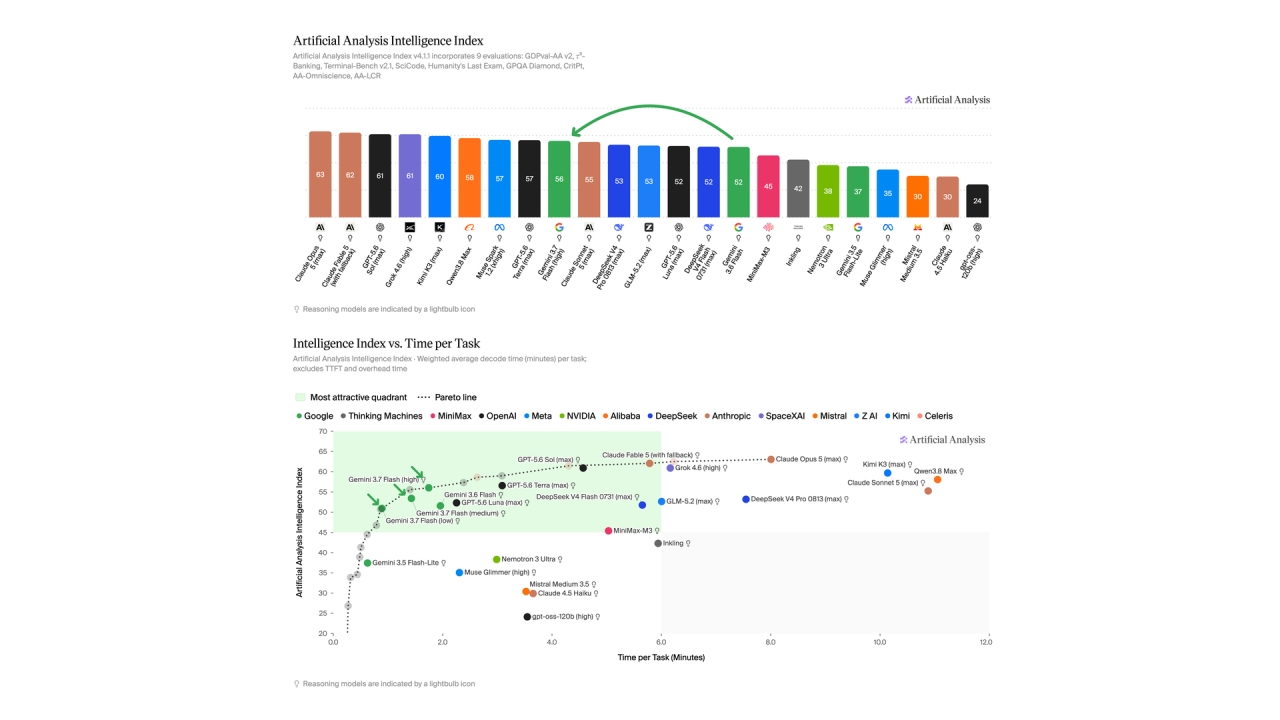
For agentic loops, tool use, and iterative coding this speed is not a nice-to-have — it changes how the model feels in practice. Fewer waiting cycles, tighter feedback loops, and lower total wall-clock time for multi-step work.
Pricing that actually moves the needle
Google is offering an introductory price through the end of 2026 of $0.75 / 1M input and $3.75 / 1M output — exactly half of the previous 3.6 Flash list price. After December 31, 2026 it reverts to $1.50 / $7.50.
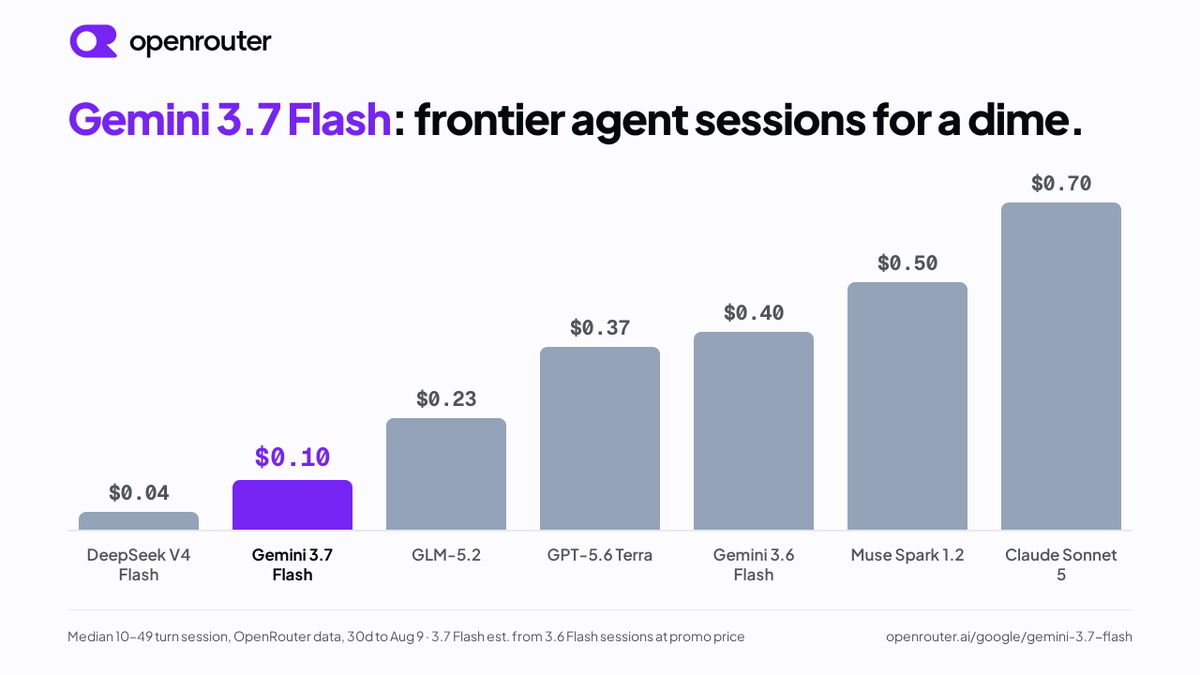
On top of that, OpenRouter is stacking an additional 50% discount exclusively through August 27, bringing the effective rate to roughly $0.375 / $1.875. That is a full 75% off the eventual regular price for a limited window. For high-volume coding agents or knowledge-work pipelines this is currently one of the strongest value propositions available.
Full performance table (official comparisons)
Here is the complete table Google / DeepMind published, showing Gemini 3.7 Flash against 3.6 Flash, Claude Sonnet 5, GPT-5.6 Terra, and Muse Spark 1.2:
| Benchmark | Notes | Gemini 3.7 Flash | Gemini 3.6 Flash | Claude Sonnet 5 | GPT-5.6 Terra | Muse Spark 1.2 |
|---|---|---|---|---|---|---|
| Input price $/1M | $0.75* | $0.75* | $2.00 | $2.00 | $1.25 | |
| Output price $/1M | $3.75* | $3.75* | $10.00 | $12.00 | $4.25 | |
| Artificial Analysis Intelligence Index | Composite | 56 | 52 | 55 | 57 | 57 |
| FrontierCode 1.1 Main | Production code quality | 43.6% | 34.4% | 42.7% | 41.3% | — |
| DeepSWE v1.1 | Long-horizon SWE | 65.3% | 48.6% | 53.8% | 69.6% | 54.9% |
| Code Arena (WebDev) | Elo | 1588 | 1538 | 1541 | 1523 | 1535 |
| Terminal-bench 2.1 | Agentic terminal coding | 85.8% | 78.0% | 80.4% | 87.4% | 82.9% |
| Terminal-bench 3.0 | General agent | 14.9% | 5.4% | 14.6% | 20.8% | — |
| AutomationBench | Enterprise workflows | 30.4% | 17.0% | 10.7% | 23.6% | — |
| GDPVal-AA v2 | Knowledge work (Elo) | 1525 | 1422 | 1598 | 1578 | 1628 |
| Harvey LAB-AA | Complex legal | 90.7% | 85.1% | 90.1% | 85.2% | — |
| GDP.pdf | Complex document reasoning | 34.0% | 22.0% | 28.0% | 24.7% | 16.0% |
| GDM-MRCR v2 (8-needle) | Long context (128k avg) | 97.0% | 91.8% | 81.5% | 93.5% | — |
| LVBench | Long video | 85.4% | 84.2% | 68.5% | 78.9% | — |
| HLE-Verified | Expert multidisciplinary | 53.6% | 51.2% | 31.0% | 51.1% | — |
| LABBench2 | Biology research tasks | 82.1% | 76.1% | 80.1% | 81.2% | — |
*Introductory pricing expires 31 Dec 2026.
Notice the pattern: 3.7 Flash leads or is competitive on the majority of coding, automation, long-context, and many knowledge-work benchmarks while undercutting the comparison set on price by a wide margin. It is not claiming to beat the absolute top frontier models across the board — the table is honest about the peer group.
Other important release details
- 1M context / 64k output, multimodal (text + image + video + audio + PDF input).
- Tunable thinking levels (low / medium / high).
- Stronger multi-step planning, tool use, and instruction following → fewer failed agent loops and less human babysitting.
- WebDev Arena Elo 1588 (up from 1538).
- Meaningful gains on complex document understanding (GDP.pdf) and enterprise automation.
- Now powering Gemini Spark for Google AI Pro/Ultra users in supported countries.
- Available immediately in the Gemini API, AI Studio, Android Studio, Antigravity, and Gemini Enterprise Agent Platform.
Bottom line
Gemini 3.7 Flash is the clearest expression yet of Google’s “intelligent workhorse” strategy: substantial capability gains (especially coding), elite speed (~340 t/s), and aggressive temporary pricing that makes the value equation extremely compelling. The comparisons are deliberately against the right peer set — Terra, Muse Spark 1.2, Sonnet 5 — not the heaviest models, which makes the results more useful for real production decisions.
For anyone running serious coding agents or high-volume knowledge workflows right now, the combination of the coding jump, the speed, the 50% Google intro price, and the extra OpenRouter 50% (through Aug 27) is hard to ignore. The model is available today — the limited-time economics make it worth testing aggressively while the discounts last.
Continue