The Boy Who Lowered His Sword: Learning Without an Audience
A parable about the fear of judgment and why learning needs room for imperfect first attempts, especially when AI offers shortcuts.

In this essay
A Tale for the lesson on the fear of being judged, the courage to be imperfect, and the quiet art of learning.
I. The Garden Where Nobody Watched
In a small village called Ohara, hidden among the mountains of Japan, there lived a boy who dreamed of becoming a samurai.
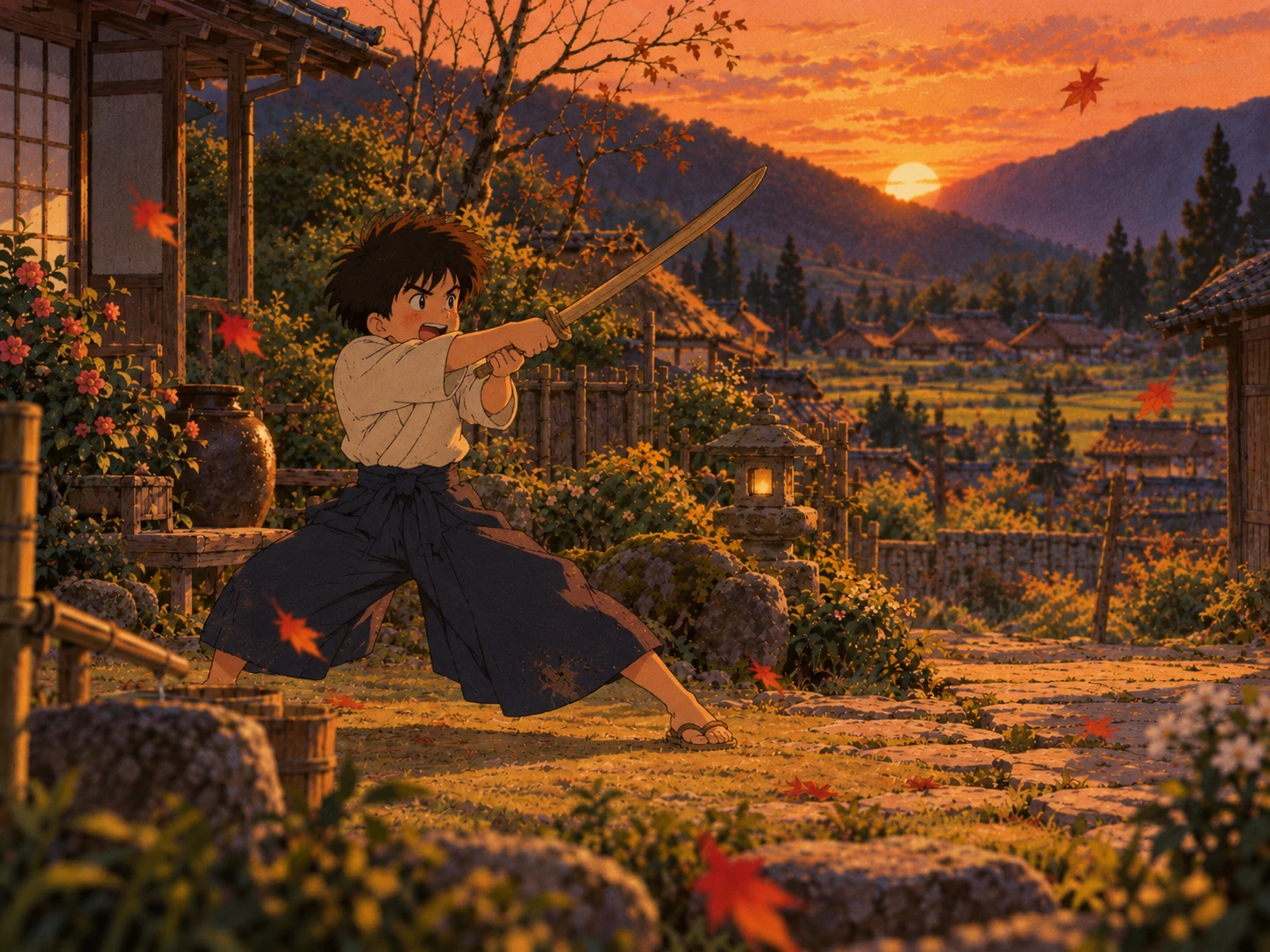
Every evening, as the sun descended behind the hills and the village settled into silence, he would slip into the little garden behind his house.
There, an entirely different world awaited him.
The moss-covered stones became ancient fortresses. The bamboo fence marked the boundaries of a distant kingdom. A crooked maple tree stood guard over an imaginary battlefield.
And in the middle of it all stood the boy, armed with a wooden sword.
He invented everything.
The villain, the kingdom in danger, the impossible duel, and even the final words spoken before victory. Sometimes he played both sides of a conversation, changing his voice as he argued with an enemy nobody else could see.
Sometimes the villain won, and he had to invent another ending.
When the battle was over, he would bow respectfully to his defeated opponent.
He was not particularly good with a sword.
His feet often stumbled over each other. His arms grew tired long before the imaginary battle was finished. Sometimes he swung too hard, lost his balance, and landed in the dirt.
But he always got up laughing.
"That doesn't count!" he would announce to an imaginary enemy, brushing the dust from his clothes.
Then he would begin again.
He never wondered whether his stance looked foolish or whether a real samurai would approve of his movements.
There were no spectators, no applause, and no expectations.
Only a boy, a wooden sword, and an imagination large enough to fill an entire kingdom.
And without realizing it, he was learning.
Each evening, his balance grew a little steadier. His movements became more deliberate. He learned how to distribute his weight, how to recover after a missed strike, and how to hold his sword even when his arms began to ache.
Nobody had graded his progress.
Nobody had even noticed it.
He was free to be terrible at something he loved.
And in that freedom, he was slowly becoming better.
II. The Footsteps
One autumn evening, the boy was preparing for the greatest battle his imagination had ever invented.
The sun hung low over Ohara, painting the rooftops amber. A gentle breeze carried red maple leaves through the garden.
The boy stood with his knees bent and his wooden sword raised high.
His imaginary opponent was formidable. The kingdom was depending on him.
He tightened his grip.
Then he heard footsteps.
Slow, uneven footsteps coming from the narrow stone path beside the garden.
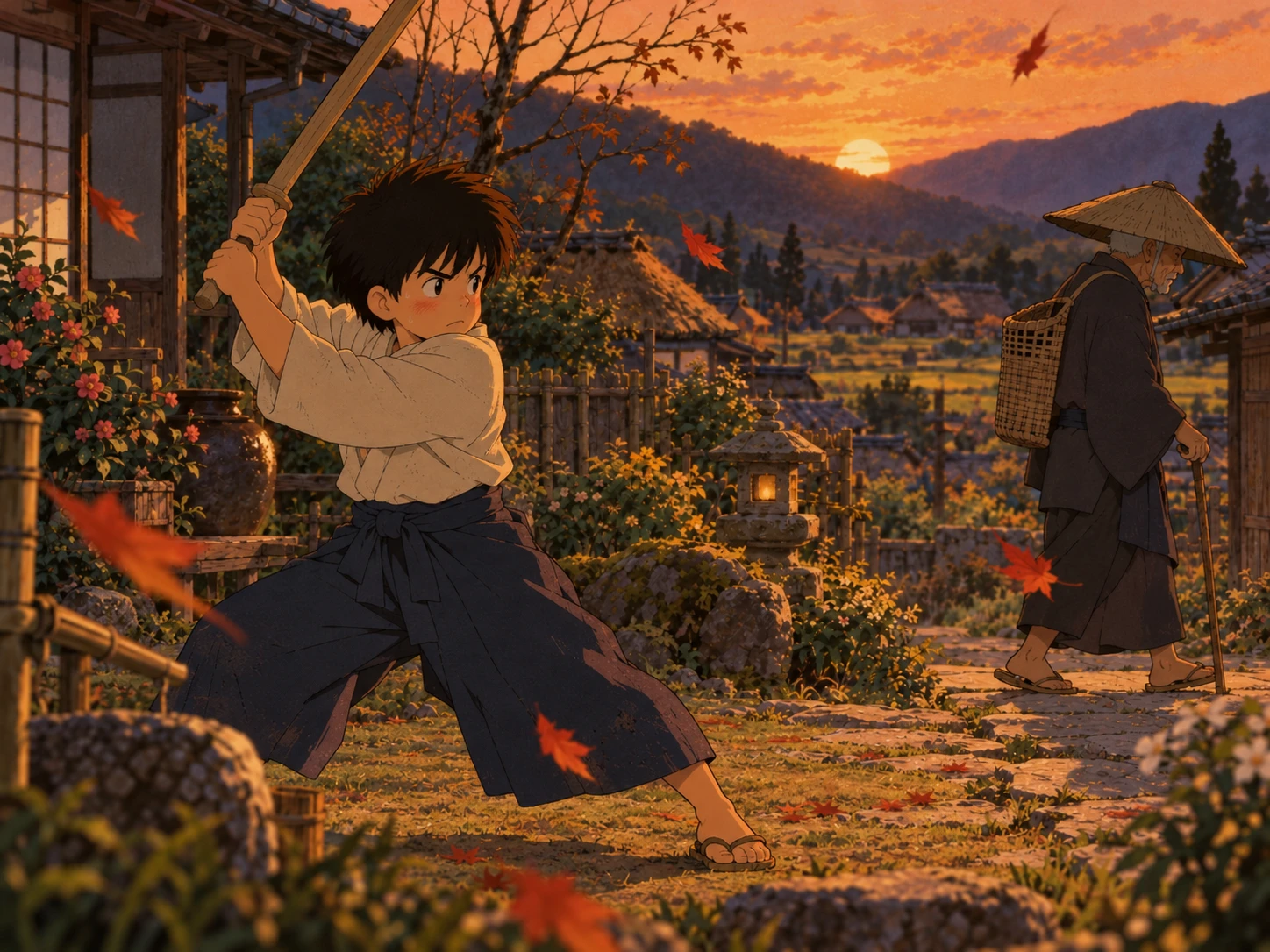
An old man was walking home, his face shaded by a wide straw hat. A woven basket rested on his back, and a wooden stick supported his steps.
The boy glanced toward him.
For a moment, everything stopped.
The battle disappeared.
The imaginary kingdom vanished.
Suddenly, the boy could see himself as the old man might see him.
Not as a brave samurai standing against impossible odds, but as a small child in oversized clothes, swinging a wooden stick at empty air.
His cheeks grew hot.
What must I look like?
Does he think I'm pretending to be something I'm not?
What if he laughs?
The sword that had felt so natural in his hands suddenly seemed awkward.
He became aware of the position of his feet, the angle of his arms, and the childishness of his imaginary battle cries.
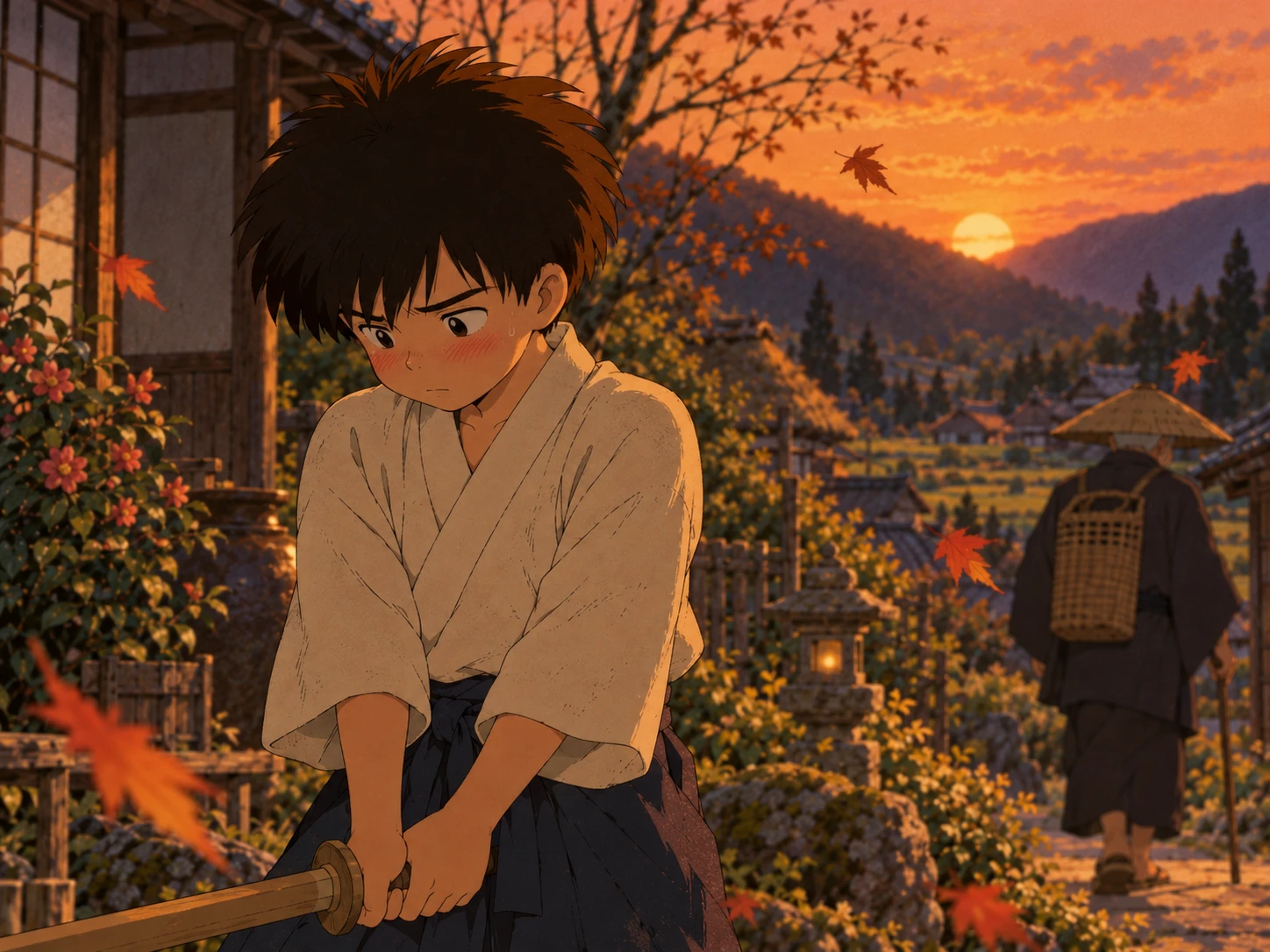
Every movement felt wrong.
Slowly, he lowered his sword.
He straightened his back, looked toward the ground, and pretended to examine the wooden blade.
As though he had been doing something sensible all along.
The old man continued walking.
His sandals scraped against the stones.
His basket swayed gently from side to side.
He passed the bamboo fence, walked beneath the maple tree, and disappeared around the bend.
He never turned his head.
Not once.
III. The Audience That Wasn't There
The boy remained motionless.
He had expected something.
A curious glance, perhaps. A smile. Maybe even a laugh.
But nothing had happened.
The garden was exactly as it had been moments earlier.
The same stones. The same crooked tree. The same wooden sword in his hands.
Only the imaginary kingdom was gone.
He looked toward the path where the old man had disappeared.
Then he remembered the words he had imagined hearing.
What a foolish boy.
He doesn't know what he's doing.
He looks ridiculous.
The words had felt so real that he had changed his behavior to escape them.
But the old man had never spoken.
He hadn't laughed.
He hadn't offered an opinion.
He hadn't even looked.
The boy had supplied every word himself.
He glanced down at his wooden sword.
A few moments earlier, he had been enjoying himself so completely that falling in the dirt had seemed funny.
Now he was ashamed of doing the very same thing.
His ability hadn't changed.
His sword hadn't changed.
The only thing that had changed was the possibility of someone seeing him.
A maple leaf drifted down and settled near his feet.
The boy stared at it for a while.
Then another thought came.
What if the old man had looked?
What if he had laughed?
Would that mean the boy shouldn't practice anymore?
He wasn't sure.
The possibility still embarrassed him.
But he remembered something from the evening before.
He had spent nearly an hour trying to perform a difficult movement. He had fallen several times, scraped his knee, and finally managed to complete it without losing his balance.
He remembered how happy that small success had made him.
The old man knew nothing about that.
He knew nothing about the boy's efforts, his failures, or the little improvements nobody else had seen.
How could one stranger's passing glance possibly tell the whole story?
The boy looked again at the wooden sword.
For the first time, he began to understand that another person's opinion, whether real or imagined, did not have to decide what he was allowed to attempt.
He still felt embarrassed.
But he missed his imaginary kingdom.
IV. Again
The evening light was fading.
The boy stood alone, listening to the rustling leaves.
He waited for the embarrassment to disappear.
It didn't.
His cheeks were still warm. His shoulders still felt strangely stiff.
For a moment, he considered going inside.
Tomorrow, perhaps, he could practice when nobody was around.
But then he looked at his sword.
And slowly, he moved his left foot forward.
He bent his knees.
Adjusted his grip.
Raised the wooden blade.
His arms trembled slightly.
He glanced once more toward the empty path.
Then he breathed out.
"Again," he whispered.
He swung.
The movement was clumsy. His balance shifted too far forward, and the tip of his sword struck a low branch.
A shower of maple leaves fell around him.
He stumbled.
For a moment, he simply stood there.
Then he smiled.
"That doesn't count," he told his invisible opponent.
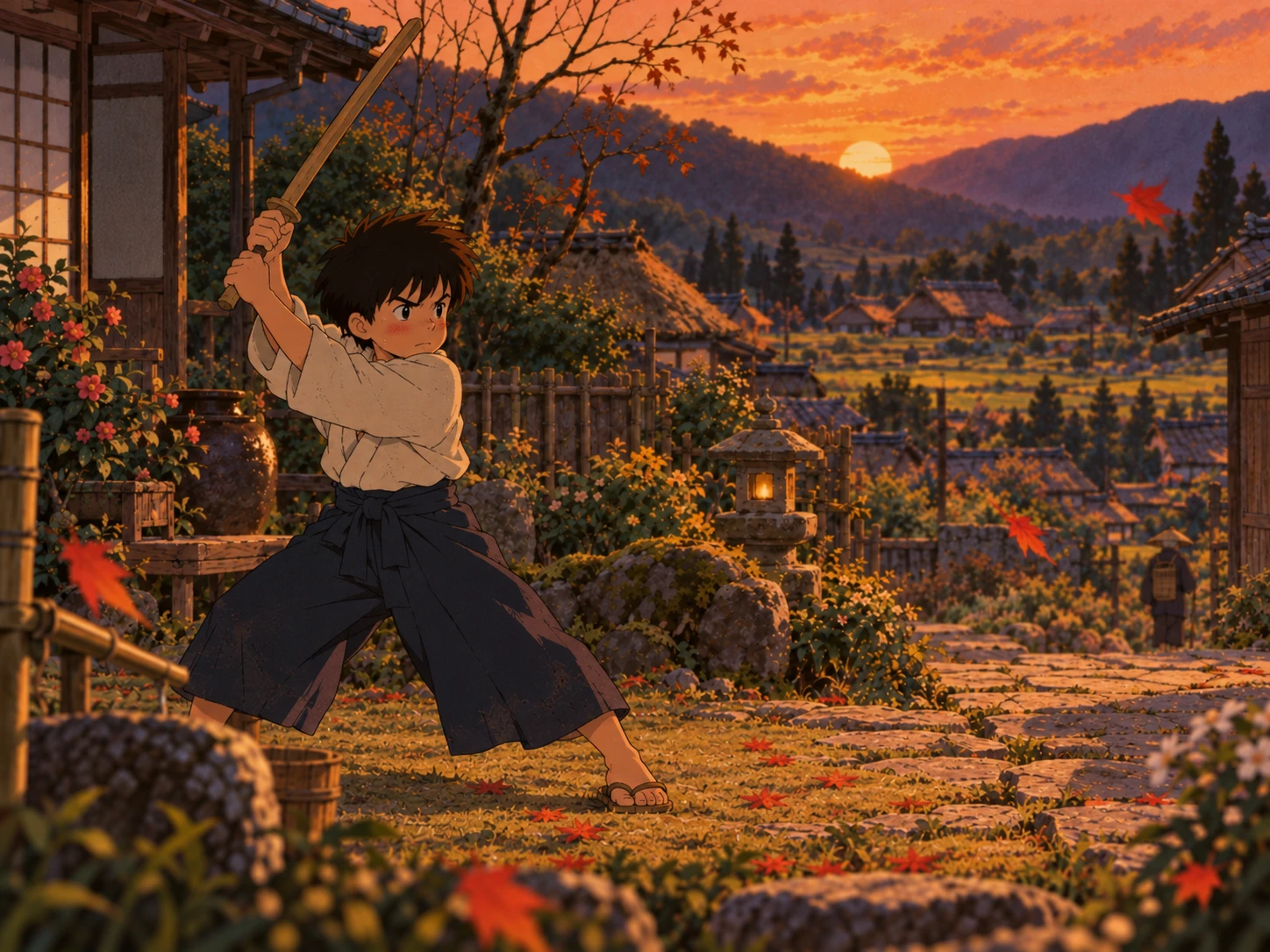
And he tried again.
His next attempt wasn't much better.
Neither was the one after that.
But he continued until the orange sunlight disappeared behind the mountains and the lantern beside the garden began to glow.
That evening, the boy did not become a great samurai.
He did not master his sword.
He did not overcome every fear he would ever experience.
Perhaps tomorrow, when someone passed the garden, he would feel embarrassed all over again.
But something had changed.
He had discovered that embarrassment could accompany him without commanding him.
He was still embarrassed.
His hands still trembled.
But for the first time, he understood that he could feel foolish and keep learning anyway.
The garden would not always be empty.
People might watch. Some might laugh. Others might offer advice.
But he could continue learning through all of it.
As the evening grew quiet, the boy raised his wooden sword one final time.
There was no kingdom left to save.
No great villain waiting to be defeated.
No audience to impress.
Just a boy learning how to hold a sword.
And, for that evening, it was enough.
V. The Red Pen in Our Own Hands
I think many of us have lived some version of that evening in Ohara.
Only our wooden swords look different.
An unfinished story we never shared. A question we swallowed because it sounded too simple. A language we stopped speaking because our pronunciation made us blush. An idea we abandoned before anyone had the chance to hear it.
Sometimes nobody judges us at all.
We imagine the verdict, then quietly withdraw.
So much of the fear of being judged is a grade we give ourselves before anyone even looks.
The red pen was already in our own hand.
Of course, judgment can be real. People can be cruel. Classrooms and workplaces can punish uncertainty; not every fear is imagined.
But something unfortunate happens when we carry that fear into moments where nobody is watching.
Practice starts to feel like an examination. We expect our first attempts to resemble someone else's finished work, and eventually avoid anything we cannot already do well.
There is a difference between wanting to improve and needing to appear competent.
Wanting to improve brings us back to practice. Needing to appear competent makes us hide it.
A writer must produce sentences that don't work. A scientist must question ideas that might fail. A student must confront what they don't understand. An entrepreneur must test assumptions that reality may reject.
These aren't signs that we lack ability.
They're how ability is built.
Every meaningful skill demands a period of imperfection, often one nobody else sees.
The first attempt was never meant to prove mastery.
It was meant to begin it.
And today, we have increasingly powerful ways to skip that uncomfortable beginning.
VI. The New Invisible Audience
Artificial intelligence has given us something remarkable.
It can explain unfamiliar concepts, challenge arguments, solve difficult problems, and help shape ideas we might otherwise struggle to express.
Used thoughtfully, it can make learning more accessible and profound.
But it can also shield us from seeing our own thinking while it is still unfinished.
Before writing a paragraph, we ask for a polished version. Before wrestling with a problem, we request the solution. Before forming our own opinion, we borrow an argument that already sounds convincing.
Sometimes that's sensible delegation. Not every task needs to become a learning exercise.
But sometimes we reach for the tool because we dread the awkwardness of our first attempt, even when nobody else will ever see it.
That's when we risk confusing two very different achievements:
Producing something impressive and developing the capability to produce it.
AI can help us deliver a beautiful essay without necessarily strengthening our writing, or reach a correct answer without understanding why it works.
We might become skilled at recognizing convincing explanations while remaining uncertain how to arrive at them ourselves.
That's not an argument for rejecting AI.
It's an argument for asking it to play a different role.
Write the imperfect argument, then ask AI to challenge your assumptions.
Attempt the problem before asking for a hint.
Explain a concept in your own words, then invite it to uncover what you've misunderstood.
There is a difference between using a tool to conceal our uncertainty and using it to explore that uncertainty.
One helps us look capable.
The other helps us become capable.
And perhaps that's the opportunity worth protecting:
Not merely making human work easier, but making human learning deeper.
The boy in Ohara could have benefited from a sword master. A good teacher would have corrected his posture, introduced new techniques, and helped him avoid repeating certain mistakes.
But the master couldn't develop the boy's balance by standing in his place.
He couldn't strengthen his arms by holding the sword for him.
And he couldn't give him the quiet satisfaction of finally accomplishing a movement he had failed a dozen times.
Some lessons can be explained.
Others must be experienced.
Learning often requires both.
So when we reach for AI, perhaps we should ask not only:
Can this tool do the task for me?
But also:
Is there something in attempting this myself that I need to learn?
Because if there is, the difficulty may not be something we should immediately remove.
Sometimes, it's the very thing we came to learn from.
Thanks for reading.