GLM-5.3: Pure Post-Training Scaling Takes the Open-Weight Lead


On this page
GLM-5.3 is out (August 14, 2026) — and it is one of the cleanest demonstrations yet of pure post-training scaling.
Z.ai (Zhipu) took the exact same 743B-parameter base model as GLM-5.2 and only scaled post-training: more long-horizon environments, more diverse task types, and significantly more compute on the stack they already had (IndexShare, SAO, slime). No new pre-training. The result is a model that currently leads the open-weight frontier on coding and shows surprisingly strong, emergent cybersecurity capabilities.
The coding jump that matters
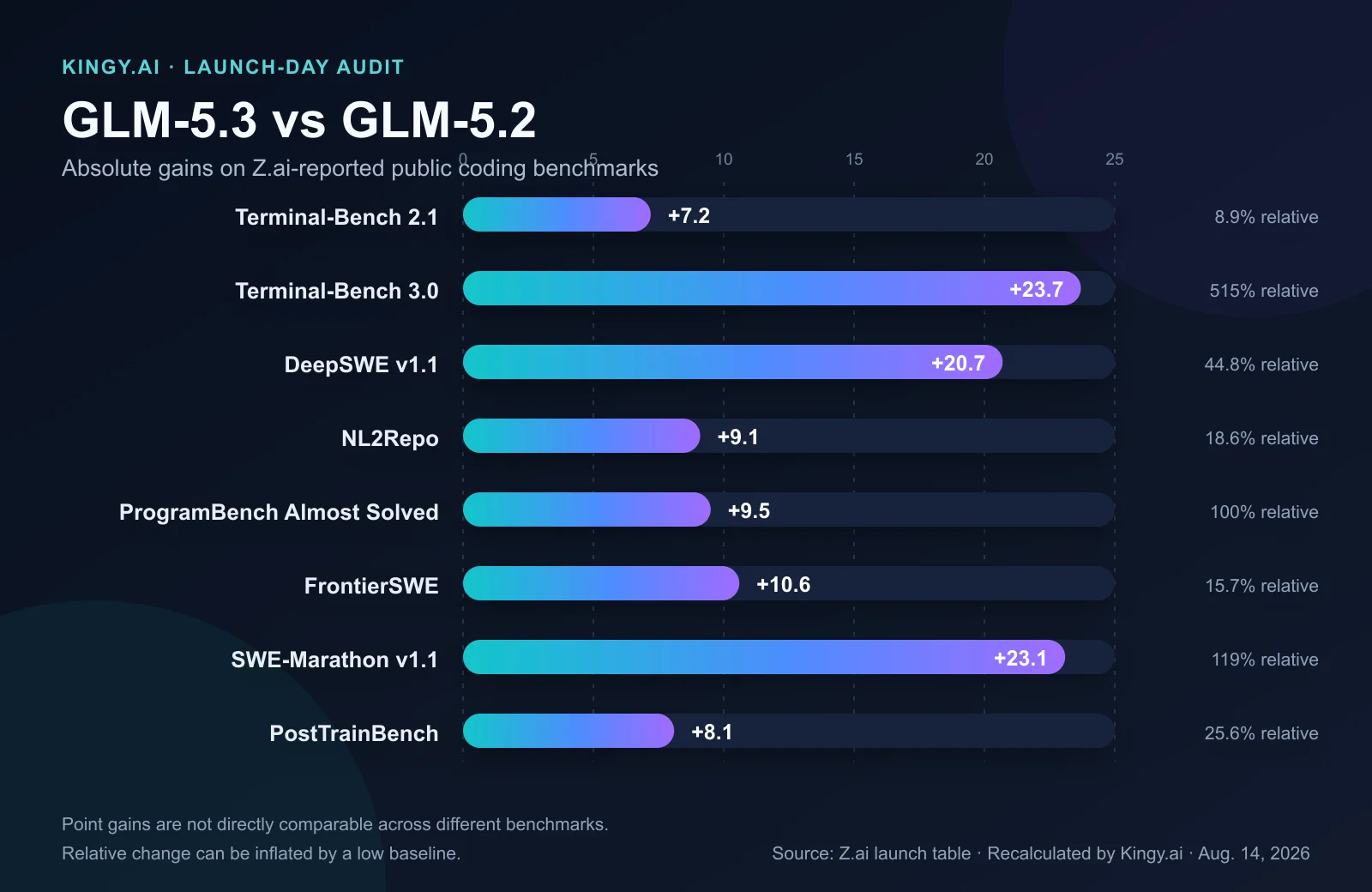
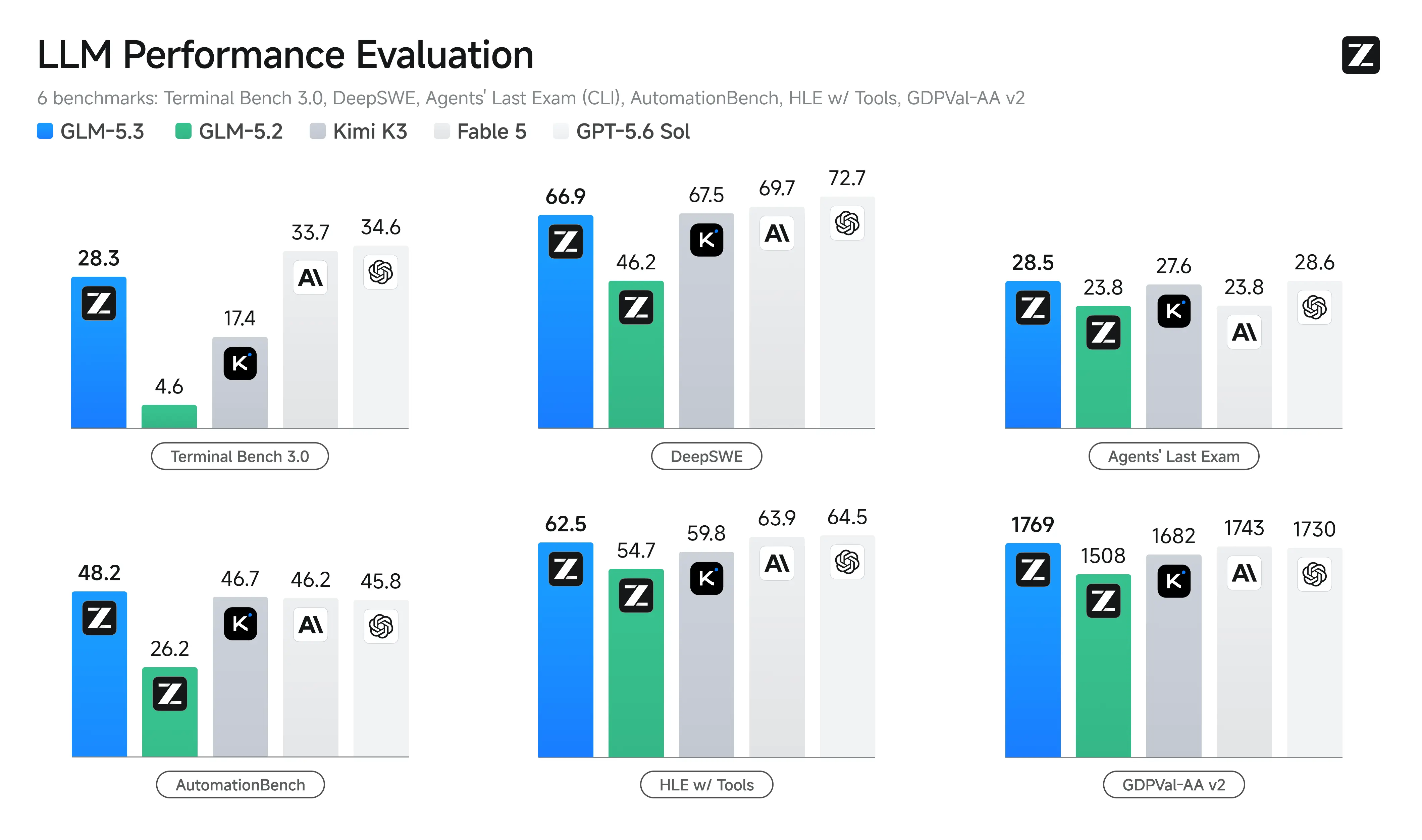
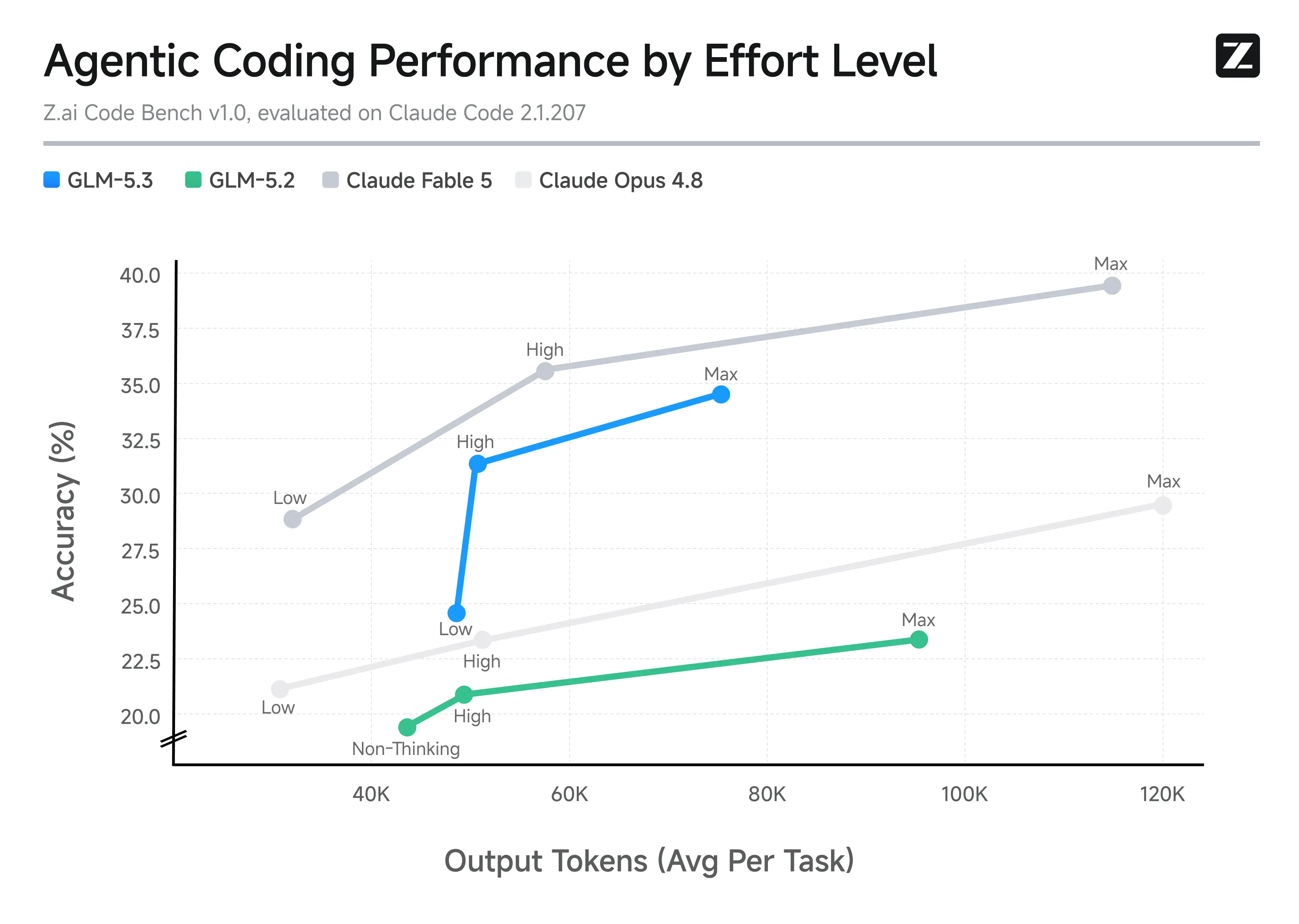
On the internal Z.ai Code Bench the team reports a ~50% improvement over GLM-5.2 in real programming feel. On public benchmarks the gains are dramatic:
- Terminal-Bench 3.0: 4.6 → 28.3
- DeepSWE v1.1: 46.2 → 66.9
- Agents’ Last Exam (CLI): 23.8 → 28.5
- SWE-Marathon v1.1: 19.4 → 42.5
- FrontierSWE: 67.5 → 78.1
These are not small incremental moves. Terminal-Bench 3.0 and the long-horizon software engineering numbers in particular put GLM-5.3 at the top of currently available open-weight models.
Cybersecurity: the unexpected leap
This is the part that feels genuinely new. As post-training scaled, cyber capability grew faster than the team expected. GLM-5.3 is now state-of-the-art on CyberGym (vulnerability discovery from white-box source) at 84.5%, ahead of the comparison set. On the harder exploitation side the jumps are even larger:
- ExploitBench: 24.4% → 54.4% (more than double)
- ExploitGym: 29/39 tasks → 105/130 tasks (2h / 6h budgets)
The model started reasoning across multi-stage exploitation chains rather than just spotting isolated bugs. Working with security researchers they have already surfaced 2,436 real vulnerabilities across 269 projects (including 1,097 medium-to-high severity issues), some dating back decades. That is a serious dual-use signal — and Z.ai is treating it as such.
Leading open-weight models right now
On the combination of coding + agentic + cyber benchmarks that matter for real agentic engineering work, GLM-5.3 currently sits at the front of the open-weight pack. It is competitive with (and in several cases ahead of) Kimi K3 and DeepSeek-V4 Pro on the key long-horizon coding suites, while remaining fully open-weight once the safety window closes.
Responsible open-weight release
Z.ai is deliberately waiting two weeks to release the weights so they can finish safety evaluation and hardening. Given the strength of the new cyber capabilities, this is the correct call. Holding the weights for due diligence instead of dumping them immediately is the mature move, and it deserves recognition.
Full comparison table (official)
| Benchmark | GLM-5.3 | GLM-5.2 | Kimi K3 | DeepSeek-V4 Pro | Qwen3.8-Max | Opus 4.8 | Fable 5 | GPT-5.6 Sol |
|---|---|---|---|---|---|---|---|---|
| Terminal Bench 2.1 | 88.2 | 81.0 | 88.3 | 87.9 | 86.6 | 85.0 | 88.0 | 88.8 |
| Terminal Bench 3.0 | 28.3 | 4.6 | 17.4 | — | — | 21.1 | 33.7 | 34.6 |
| DeepSWE v1.1 | 66.9 | 46.2 | 67.5 | 62.7 | 56.6 | 58.0 | 69.7 | 72.7 |
| CyberGym | 84.5 | 77.2 | 80.0 | 83.3 | 78.5 | 78.1 | 83.8 | 83.6 |
| ExploitBench | 54.4 | 24.4 | 32.2 | — | 28.8 | 40.0 | 78.0 | 76.5 |
| GDPval-AA v2 | 1769 | 1508 | 1682 | 1590 | 1739 | 1588 | 1743 | 1730 |
| Agents’ Last Exam (CLI) | 28.5 | 23.8 | 27.6 | 25.7 | 27.0 | 25.7 | 23.8 | 28.6 |
| AutomationBench | 48.2 | 26.2 | 46.7 | 43.2 | 39.8 | 41.0 | 46.2 | 45.8 |
(Additional rows for NL2Repo, ProgramBench, FrontierSWE, SWE-Marathon, Toolathlon, etc. available in the official blog.)
Availability
- Live now for GLM Coding Plan subscribers and inside ZCode.
- API access rolling out.
- Open weights expected ~August 28 after the safety window.
Bottom line: Same architecture, aggressive and well-engineered post-training, clear leadership among open-weight models on the coding + long-horizon tasks that actually matter, plus an emergent cyber capability that is strong enough that the team is wisely delaying the weight release. This is exactly the kind of focused, high-signal progress the open ecosystem needs.
Full technical write-up, methodology notes, and additional charts are on the official Z.ai blog: https://z.ai/blog/glm-5.3
The engineering story here is very similar to what we saw with the recent Grok and DeepSeek post-training jumps — capability can move a long way after the base is frozen when the post-training stack is mature.
Continue